
Before I ever worked in recruiting and HR, I spent three seasons at a Halloween store. You know the kind. It shows up every fall in whatever abandoned building you least expect and is gone by the first week of November.
Every year meant a new address, a new manager, and a new group of people who somehow turned empty shelves and total confusion into a working store.
If you’ve ever walked through one, you already know the vibe. Half haunted house, half fire hazard, 100% chaos.
And somehow, every single season, the lights came on, the fog machines sputtered to life, and people left happy. Whether it meant zip-tying a display together or taping ripped packaging back up, we figured it out.
Year One: The Haunted Babies-R-Us
Our first store was an old Babies-R-Us that had been sitting empty for two years. The poles were still mint green, the word “Diapers” still hung in giant letters, and the floors had grime outlines everywhere the shelves used to be. The bathrooms were a war crime.
Trucks showed up whenever they felt like it, and nobody knew what was on them until the boxes came off the dolly. Sometimes we got fifty, sometimes two hundred, and the packing list was never right. Occasionally a giant box would have one lonely item rolling around at the bottom. Other times we’d open one up to find five hundred cans of the same purple hair spray.
I avoided the register like the plague and stuck to the floor, reorganizing displays and keeping an eye out for shoplifters. People stole EVERYTHING. Fake knives, clown wigs, fog machines… retail theft, but make it spooky.
The soundtrack never changed. Jimmy Buffett, Crowded House, and a few other classics on a loop all day long. Cheeseburger in Paradise basically became our unofficial survival anthem.
When teardown week came, we packed up the whole store in record time and then sat there for five hours waiting on a truck that never came because of a blizzard. We just watched the snow bury our cars through the glass doors. Nobody said a word.
Then the entire staff at a nearby location quit the day after Halloween, so we got to pack up their store too. (I learned a lot of patience that year. I did not ask for it.)
Year Two: The Mall Office With No Bathroom Door
The next year, we moved into an old physical therapy office inside a mall. It was cleaner, but the bathroom didn’t have a door, so we all used the public one down the hall. The light switches were hidden way back in a maintenance tunnel, which meant whoever opened each morning got a little horror movie walk before the sun came up.
The manager that year was steady and reasonable, and he’d made an actual career out of this. Halloween, then Christmas, then Easter displays at the mall, over and over. I could never handle that much uncertainty, but it worked for him.
The rest of the crew was a mix of teenagers, returning staff, and one coworker who went by the name of a ringed planet. She signed legal documents with a tiny planet doodle. By week two, nobody even blinked. (Retail will normalize things that would never fly anywhere else.)
Same soundtrack, too. Don’t Dream It’s Over played about four times a day, which felt equal parts taunting and supportive.
Even with all that, the team clicked. Everybody figured out their part and kept the place running without much fuss. That was the year I realized a store doesn’t run because there’s a perfect process. It runs because the people in it decide they’re not gonna let it fall apart.
Year Three: The Vacant Sears
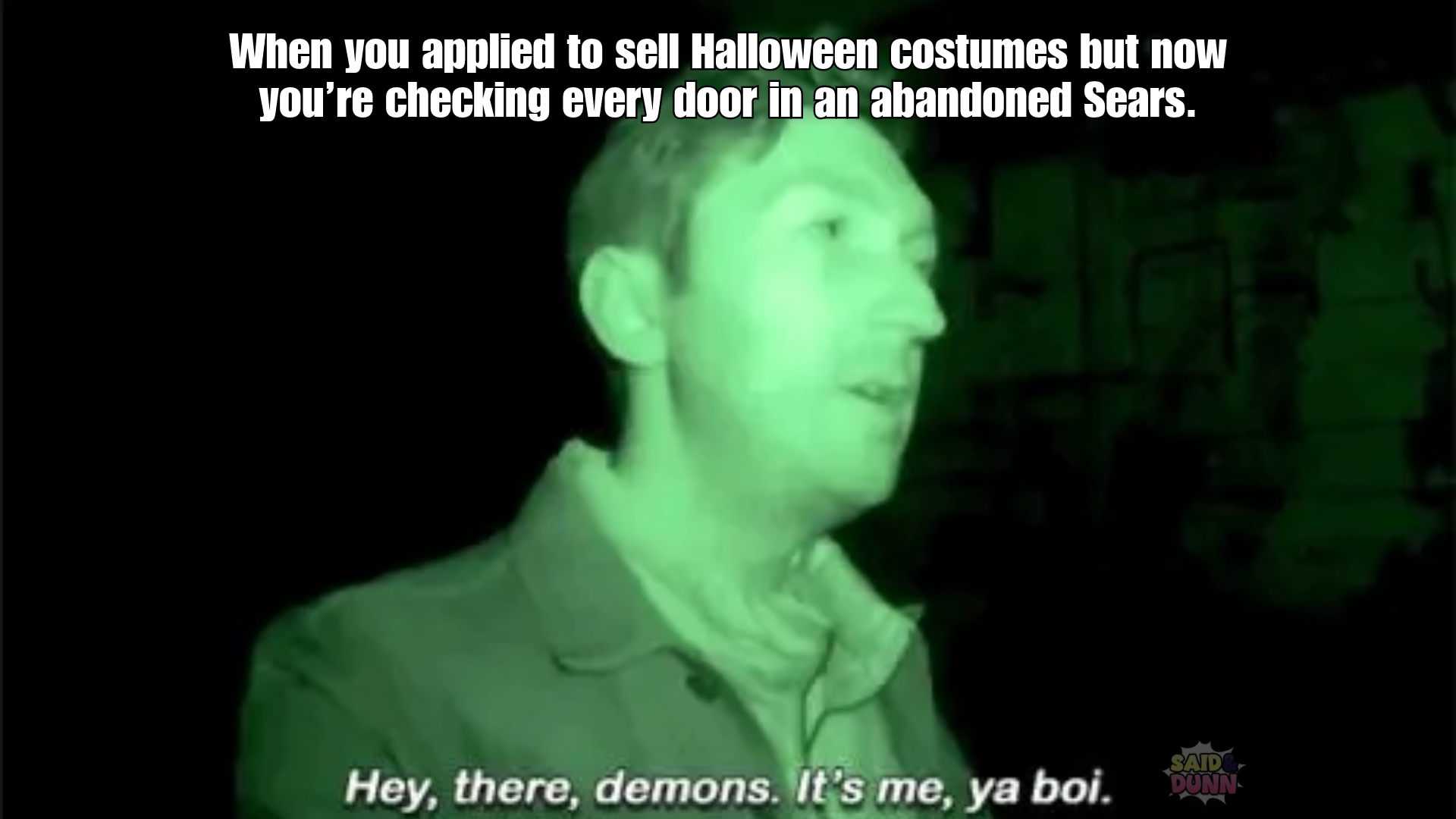
By year three, I’d accepted that figuring it out WAS the job. This time we were inside a closed Sears. Huge, echoey, and mostly dark, with only a small section open and the rest blocked off behind temporary walls.
I built displays and set up the animatronics: lunging zombies, screaming clowns, and fog machines that coughed more than they actually fogged. Customers screamed, laughed, and took pictures, which we counted as positive feedback.
Every night before close, I had to walk the whole perimeter with my phone flashlight and check doors that hadn’t been opened in years. That building was too quiet. The kind of quiet that makes you walk a little faster and not talk about why.
The team was small and easygoing. Everyone did their job, jumped in where they were needed, and shared snacks during the slow hours. Nothing glamorous, but it worked.
When the season ended, the space turned into a Planet Fitness that I now go to regularly. Way less spooky.
So What Do You Do With Jobs Like This?
Three seasons at a Halloween store doesn’t exactly sound like career gold. But the jobs we tend to write off, like retail, food service, temp work, or that one chaotic summer job, are usually where a lot of us actually learned how to work.
Think about what that store asked of everyone in it. Unloading trucks when nobody knew what was coming. Setting up a sales floor in a building that was never meant to be one. Watching for theft, dealing with customers who wanted refunds on costumes we never even carried, and closing out a season in the middle of a blizzard. Nobody handed us a manual for any of it.
That’s real experience. The problem is that “Seasonal Sales Associate” doesn’t tell a hiring manager any of that, and they’re not going to guess. (Same issue as job titles that don’t explain what you actually did.)
If you’re deciding whether those jobs belong on your resume, ask whether they show something the job you want actually needs. A seasonal retail job might be the best proof you have that you can handle a constant stream of customers, adapt when plans change, or get a space ready on a deadline. If so, put it on there and spell out what you did instead of writing “assisted customers” and moving on. If your more recent experience already covers it, you don’t need to list every shift you’ve ever worked. Your summary can connect the dots for the rest.
These jobs are great for interviews too. When someone asks about a time you dealt with a difficult situation or had to figure something out on your own, a story about a missing truck and five hundred cans of purple hair spray is a lot more memorable than a vague answer about “staying flexible.” Just make sure you connect it back to the job you’re interviewing for so they’re not left wondering why you’re telling them about a haunted Babies-R-Us.
Because whether it’s a closed-down Sears or your current nine-to-five, the job’s pretty much the same. Turn on the lights, deal with whatever shows up, and figure it out.
Wait, what is this blog?
Hiring. Social media. Internet culture. Gaming.
Long ago, these four topics coexisted peacefully. Then everything changed when I started a blog full of memes.
Subscribe to Said & Dunn to get new articles sent straight to your inbox. No algorithm required.
Related
Discover more from Said & Dunn
Subscribe to get the latest posts sent to your email.